.png)

.png)
Let's Get Uncomfortable for a Second
If your LinkedIn B2B marketing strategy still starts with "okay, how many leads can we get?" Congratulations. You are running 2016 thinking on a 2026 platform.
Buyers don't wake up, scroll LinkedIn, see your ad, and think: finally, a whitepaper. Take my budget.
They scroll. They notice. They forget. Then they remember you three months later in a meeting when someone says, "Has anyone heard of these guys?"
That is not LinkedIn lead generation. That is LinkedIn demand generation. Different job. Completely different scoreboard. And most B2B teams are still playing the wrong game.
Why LinkedIn B2B Marketing Looks "Expensive"
Every B2B team has said it at least once: "LinkedIn is too expensive."
No. Your attribution model is lazy.
You are asking LinkedIn to prove itself using last-click credit, form fills, and demo requests. Which sounds rigorous. It is not.
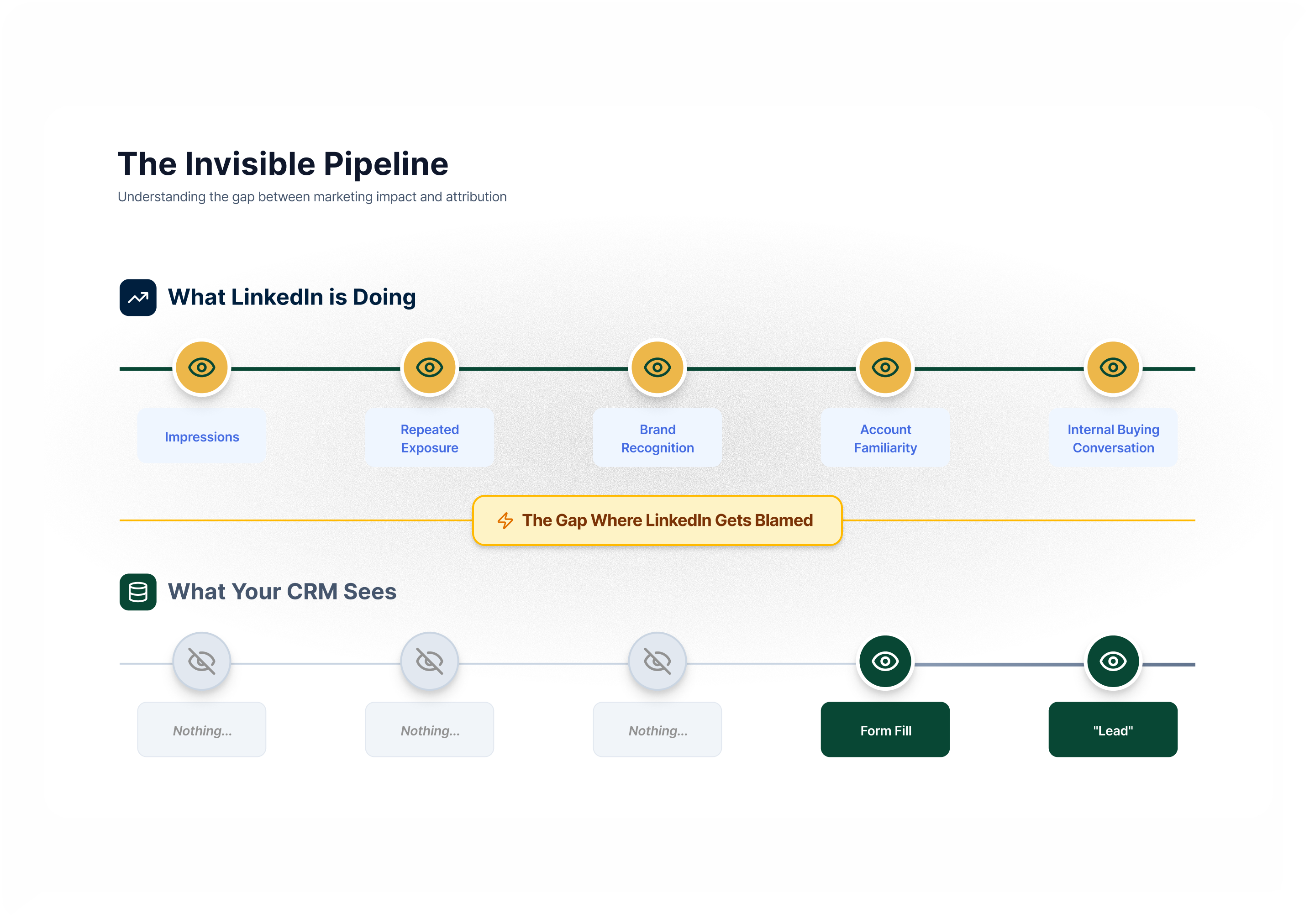
By the time a deal lands in your CRM, your LinkedIn B2B marketing has usually already shaped perception, built familiarity across multiple stakeholders, and warmed the account up for weeks, sometimes months. But none of that shows up in the report. So it looks like nothing happened.
Then you give all the credit to the last webinar someone clicked. Feels clean. Totally scientific. Completely wrong.
The channel doing the invisible work keeps losing the budget argument because the tools measuring it were built for a different kind of purchase. LinkedIn is not Google. A click is not the point.
The Lie at the Center of Most B2B LinkedIn Strategy
Here is the lie most teams are operating on: if it did not convert, it did not work.
That logic holds if you sell low-cost products to single buyers with zero internal politics. So, not B2B.
Real B2B buying involves multiple stakeholders, long evaluation cycles, and internal debates you will never see. Your LinkedIn content marketing is not there to close deals in the moment. It is there to survive those internal debates before you even know they are happening.
If your brand is not already familiar when the buying conversation starts, you are late. Not a little late. The kind of late where you are being compared to a shortlist you were never on.
A smart b2b linkedin strategy understands this. It is not trying to convert cold audiences into leads on the first impression. It is trying to make sure that when the moment arrives, your name is not a stranger.
So What Is LinkedIn B2B Marketing Actually For?
Simple version. LinkedIn B2B marketing is for shaping category perception, staying visible during long buying cycles, and influencing accounts long before intent becomes obvious.
It is not a vending machine for leads. It is not a replacement for sales. It does not produce magic results in a 30-day window.
A good linkedin marketing strategy for b2b does not spike your conversions. It raises your odds when the deal finally shows up. Which is genuinely hard to measure. And very easy to ignore, especially when your CMO wants a number by Friday.
This is why most teams still default to lead gen metrics even when they know, somewhere deep down, that those metrics are lying to them.
Why Most Teams Still Get This Wrong in 2026
Because dashboards reward easy numbers, fast feedback, and the appearance of certainty.
Pipeline influence is messy. It does not fit neatly into weekly reports. There is no obvious screenshot for "our LinkedIn activity warmed up 34 accounts that later closed through organic." So teams reach for what is easy to show. CTR goes up. Everyone nods. Revenue stays confused.
LinkedIn keeps getting blamed for being expensive. The actual problem, a measurement gap, never gets fixed. So the cycle repeats.
The teams getting this right in 2026 have stopped asking "how many leads did LinkedIn generate" and started asking "how many accounts that became pipeline were touched by LinkedIn first." Those are different questions. The second one almost always makes LinkedIn look much more valuable.
The Demand Generation Mindset Shift
LinkedIn demand generation is not a tactic. It is a frame.
It means accepting that influence happens before intent. That your ads are doing work you cannot see yet. That the right question is not "did this person click" but "was this company paying attention."
It means measuring differently. Not just CPL and conversions, but account reach, impression depth across target accounts, and pipeline overlap. How many of your closed deals this quarter were companies you had been running LinkedIn ads against for 60 or 90 days? That number tells a better story than CTR.
It also means having an honest conversation with leadership about what LinkedIn is actually being hired to do. If the answer is still "generate leads," the measurement problem will never get solved. Because you will keep optimizing for the wrong output and wondering why the channel feels broken.
Final Thought Before You Launch Another Lead Gen Campaign
If your linkedin b2b lead generation strategy is still being judged only by leads, CPL, and platform conversions, then no amount of creative testing will fix what is wrong.
You do not have a campaign problem. You have a measurement problem. And a framing problem. And possibly a difficult conversation with your leadership team that keeps getting postponed.
Until you connect LinkedIn activity to real pipeline movement, you will keep underinvesting in the channel doing most of the invisible work. You will keep cutting budgets in Q3 because the dashboard did not show enough leads in Q2. And your competitors who figured this out first will keep showing up in deals you thought came from nowhere.
The good news is the data is there. The overlap between your LinkedIn audiences and your CRM pipeline exists. You just need to look at it differently.
Start there.
Frequently Asked Questions
What is the difference between LinkedIn lead generation and LinkedIn demand generation? Lead generation asks for something. A form fill, a demo request, a contact detail. Demand generation gives something first. Content, perspective, familiarity. In B2B LinkedIn marketing, lead gen captures people who are already close to buying. Demand gen reaches people before they know they are buying. The mistake most teams make is running demand gen tactics while measuring them with lead gen metrics. The numbers look bad. The channel gets blamed. The actual problem is the mismatch.
Is LinkedIn B2B marketing actually worth the cost? At face value, no. The CPCs are high and the direct conversion rates are low compared to Google. But that comparison only holds if you are measuring the same way. LinkedIn is not where B2B deals close. It is where they begin. The accounts that eventually convert through organic search, cold outreach, or a sales call were often already seeing your LinkedIn ads for weeks or months before that happened. When you measure LinkedIn against what it is actually doing, which is warming accounts before intent shows up, the cost looks very different.
Why do LinkedIn lead gen forms underperform for B2B? Because the timing is wrong. Lead gen forms ask for commitment from people who are in scroll mode, not buying mode. In B2B, most people who see your ad are not evaluating vendors yet. They are vaguely aware a problem exists. Asking them for their email at that stage produces low-quality leads that sales hates and marketing defends. The form is not the problem. Deploying it before you have built any familiarity is the problem.
How do you measure LinkedIn B2B marketing if not by leads? Start by looking at account-level reach. Which companies in your target list are seeing your campaigns? Then look at your CRM pipeline and ask how many of those companies showed up as opportunities in the last 90 days. The overlap between those two groups is your LinkedIn influence rate. That number tells you what Campaign Manager never will: how many deals had LinkedIn in the background before they ever raised their hand.
What should a B2B LinkedIn strategy actually optimize for? Impression depth across your target account list, not click-through rate. Consistent visibility with the right companies over time, not viral engagement. Recognition when a sales rep reaches out, not form fills from people who will never buy. The tactical question is not "how do we get more leads from LinkedIn." It is "how do we make sure every company on our ICP list knows who we are before our sales team calls them." That is the version of b2b linkedin strategy that actually moves revenue.
How long does LinkedIn demand generation take to show results? Longer than anyone wants to admit. B2B buying cycles run 6 to 18 months, and LinkedIn is working at the beginning of that cycle, not the end. If you run LinkedIn campaigns for 30 days and measure results in 30 days, you are looking at the wrong window. Teams that get this right measure LinkedIn influence on a rolling 90 to 180 day basis and look at pipeline quality, not just pipeline volume. The signal is there. You just have to be willing to look for it in the right place.
Want to see which accounts your LinkedIn ads are warming up before they ever reach your CRM? That is exactly what Attributter shows you. Account-level LinkedIn influence, connected to your pipeline, without the spreadsheet gymnastics.



.png)